








Today, accelerating globalisation, market demands, and competition drive companies’ expansion and utilisation of multiple offices across cities, countries, and continents. This growth isn’t just about physical presence; it is about meeting market demands and beating the competition through the establishment of secure, seamless, and resilient IT infrastructure that is robust and scalable to support expanded operations, enhance collaboration, and exploit your competitive edge.
Digital transformation has further accelerated this need, with data management becoming mission-critical for business operations. According to Statista, global spending on digital transformation is expected to reach $3.9 trillion by 2027, a significant portion of which will be allocated to expanding and enhancing IT infrastructure across multiple sites. This growth is not limited to large corporations; mid-sized businesses and even startups are increasingly adopting multisite strategies to tap into diverse talent pools and markets.
While setting up IT infrastructure for digital transformation at a single location may seem simple, deploying systems and new technology across multiple geographically dispersed sites presents significant challenges. This is where the concept of multisite IT deployment comes into play.
What Is Multisite IT Rollout or Deployment?
A multisite IT deployment, also known as an IT rollout, involves efficiently and effectively implementing new technologies across various locations, including retail outlets, offices, and other facilities. As industries such as healthcare, manufacturing, retail, hospitality, finance, and the public sector increasingly prioritise enhanced security and intelligence in their operations, it becomes crucial to approach IT rollouts with a methodology that ensures timeliness, reproducibility, and predictability throughout the plan design, implementation, management, and support phases.
However, expanding IT infrastructure across multiple locations is not without its challenges. Organisations must navigate the complexity of technological, logistical, and cultural hurdles to ensure seamless operations. The need for standardised systems, permissions, secure data transmissions and ensure consistent user experiences across all locations has never been more critical. In addition, organisations face several challenges in multisite IT deployments due to a lack of planning, understanding, and cooperation compounded by uncertainty.
Challenges in Multisite IT Deployments and Rollout
Geographical Dispersion
Managing IT deployments across various locations, often in different time zones and countries, can be logistically challenging. This dispersion can lead to communication breakdowns, delays in decision-making, and difficulties in maintaining consistent standards across all locations.
Diverse Infrastructure
Each site may have different existing infrastructure, hardware, and software configurations, making standardization difficult. This diversity can result in compatibility issues, increased complexity in management, and higher costs for integration and maintenance.
Regulatory Compliance
Different regions have varying regulatory requirements, especially concerning data privacy and security. The GDPR in Europe is an example of regulations that can complicate multisite IT rollouts. Ensuring compliance across all locations requires careful planning, expert knowledge of local laws, and often significant resources.
Cultural and Language Barriers
Cultural differences and language barriers can lead to miscommunication and project delays when deploying systems across different countries. Research by the Project Management Institute shows that 30% of project failures are due to poor communication. These barriers can affect everything from user adoption to the effectiveness of training programs.
Budget Constraints and Project Delays
Multisite IT deployments often require significant time investment, and budget overruns are common. A study by McKinsey found that large IT projects run 45% over budget on average. Balancing the need for comprehensive, high-quality deployments with financial constraints can be a significant challenge for many organisations.
Skill Gaps
Finding skilled IT professionals in all locations can be challenging, potentially leading to inconsistent implementation quality. This can result in delays, quality issues, and increased costs as organizations struggle to find and retain qualified personnel.
To overcome these challenges and ensure successful multisite IT deployments and rollouts, organisations can follow these tips:
7 Tips to Ensure Successful Multisite IT Infrastructure Rollouts
1. Conduct Thorough Site Assessments
Before starting any IT deployment, conduct comprehensive assessments of each site’s existing infrastructure, network capabilities, and potential challenges. This crucial step helps identify potential challenges in integrating new systems like smart devices, digital signage, kiosks, and IoT devices or upgrading to modern VoIP and POS systems.
2. Develop a Detailed Project Plan
Create a comprehensive project plan that outlines timelines, milestones, resource allocation, and contingencies for each site. This plan should be flexible enough to accommodate site-specific needs while maintaining consistency. Include milestones for each phase, from initial cabling buildouts to final deployments. Utilise project management tools that allow real-time collaboration and tracking across multiple sites.
3. Efficient Logistics and Deployment
Establish a robust supply chain network with reverse logistics expertise to effectively and efficiently manage your IT assets like laptops, smartphones, and servers across all your locations. Implement a strategy for smooth on-site installations and IMAC services, minimizing downtime during hardware deployments and system migrations. This approach minimises shipping times, reduces costs, and ensures consistent quality across all locations.
| Watch Webinar Mastering Global IT Supply Chain in a Multisite Setup |
4. Robust Security Implementation
Develop and implement comprehensive security protocols across all sites, including network security, access controls, and employee training on end-of-life (EOL)/decommissioning security best practices. Conduct regular security audits and penetration testing to maintain a strong security posture across your IT infrastructure.
5. Ensure Regulatory Compliance
Stay informed about local, state, and national regulations to ensure your IT deployments and technology refreshes comply with all relevant laws and standards, particularly regarding data privacy, security, and environmental impacts. Partner with local legal experts and conduct regular compliance audits in pursuit of Zero-Trust and Zero-Waste goals.
6. Streamline Asset Reclamation and Replacement Processes
Implement a centralised system for asset procurement, reclamation, and replacement processes. This includes tracking laptops, servers, mobile devices, and specialised equipment across all locations. Utilise intelligent inventory management tools for demand planning and supply chain optimisation. This ensures optimal management of data-bearing devices such that required hardware and software for each site are available most cost-effectively.
7. Continuous Monitoring and Optimization
Implement systems for ongoing monitoring and optimisation of your multisite IT infrastructure. This allows for quick identification and resolution of issues and continuous improvement of the performance of all IT assets across your multisite infrastructure.
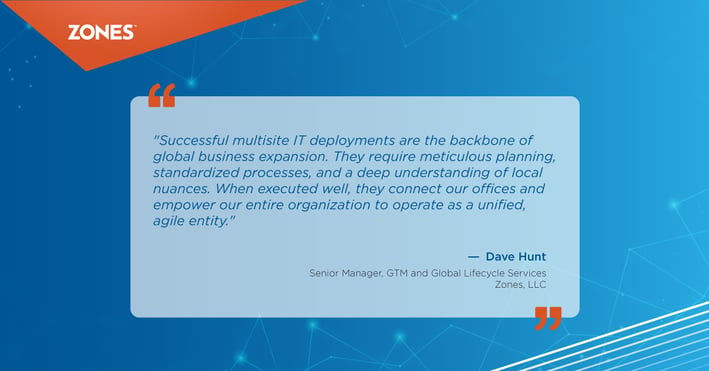
Get Ready to Expand Your IT Infrastructure with Multisite IT Deployments
The path to successful multisite IT deployments may be complex. Still, with careful planning, robust strategies, and a commitment to best practices, you can overcome challenges and reap the benefits of a unified, efficient, and scalable IT ecosystem. By doing so, you can position yourself for current success and future growth and innovation in an increasingly digital and distributed business world.
Ready to revolutionise your multisite IT infrastructure?
Let Zones help you in the process. Contact our expert team who can advise on implementing these best practices and achieve seamless multisite IT deployments.
Don’t let geographical boundaries limit your IT potential – contact us today!